Game Fishing Association Australia
  Game Fishing Record Application
To apply for a Game Fishing Record or to become a member of a Capture Club, print out the application form and complete it and forward to your Club Secretary.

Australian Record Requirements

Gamefish captures can only be considered for Game Fishing Association of Australia (GFAA) record status if they are caught according to GFAA Rules.

Following is the information and procedures for filing claims. A fee of $20.00 (inc GST) is required for filing an Australian Recod Application. All materials submitted become the property of GFAA.


AUSTRALIAN RECORD CATEGORIES

General Information

  1. GFAA maintains Australian records for both freshwater and saltwater gamefishes in line class, tippet class and all tackle categories.
  2. To qualify for official recording and granting of GFAA records, gamefih, rays and sharks must be caught by a financial or life member of a club affiliated with a state branch of GFAA. In order to qualify for a vacant GFAA record a fish must be at least equal in weight to the line or tippet class in which the record is claimed. For a fish to replace an existing record it must outweigh the current record by an amount as shown in the section "WEIGHT REQUIRED TO DEFEAT OR TO TIE AN EXISTING RECORD" under Regulations Governing Record Catches.
  3. No application will be accepted for fish caught in hatchery waters, sanctuaries or banned fishing areas in national parks. The catch must not be at variance with any laws or regulations governing the species or the waters in which it was caught.
  4. GFAA will not accept any record application generated from within a non sanctioned tournament other than an internal club competition.
  5. When an additional species of gamefish is made eligible for GFAA Records the effective date will be announced. Fishes caught on or after this date will be eligible for records. An announcement of additional species will be made in the Australian Game Fishing Records and Rules or by notification to State Association Secretaries.

Categories

Records may be claimed in the following categories and sub-categories.

Saltwater

A. Mens
B. Womens
C. Juniors - Persons who have not attained the age of 16 years. A Junior angler may hold junior, men's or women's records and all tackle records if eligible.

Freshwater

A. Mens
B. Womens
C. Juniors - Persons who have not attained the age of 16 years. A Junior angler may hold junior, men's or women's records and all tackle records if eligible.

Saltwater Fly

For saltwater recognised species
A. Mens
B. Womens
C. Juniors - Persons who have not attained the age of 16 years. A Junior angler may hold junior, men's or women's records and all tackle records if eligible.

Freshwater Fly

For freshwater recognised species
A. Mens
B. Womens
C. Juniors - Persons who have not attained the age of 16 years. A Junior angler may hold junior, men's or women's records and all tackle records if eligible.

Landbased Saltwater

For anglers fishing from the land, bridge, pier and other structures or platforms that are not free floating.
A. Mens
B. Womens
C. Juniors - Persons who have not attained the age of 16 years. A Junior angler may hold junior, men's or women's records and all tackle records if eligible.

Line Class Categories

Line Class records are maintained according to wet testing strength of line used by the angler (See Appendix A for testing standards). Records are kept in the following line class categories: 1kg, 2kg, 3kg, 4kg, 6kg, 8kg, 10kg, 15kg, 24 kg, 37kg and 60kg.

All Tackle Records

All tackle records are for the heaviest capture of each GFAA-recognised gamefish species caught under GFAA Record Requirements, Rules and Regulations and Line Categories.

Fly Rod Categories

Australian fly rod records are maintained according to the tippet strength of line used by the angler. The tippet is wet tested using the same procedure as for other lines. Records are kept for the same recognised saltwater and freshwater species in the following tippet classes: 1kg, 2kg, 3kg, 4kg, 6kg, 8kg, 10kg and 15kg.

REGULATIONS GOVERNING RECORD CATCHES

General Information

  1. Protest applications on disputed existing records will be referred to the GFAA Executive for review. Its decision will be final. All GFAA decisions will be based upon the intent of the regulations.
  2. When a substantial award is specifically offered for an Australian Record catch only a claim for an All Tackle Record will be considered. Note; GFAA disapproves of the offering of substantial rewards for the apture or tagging of fish. This practice is not in the best interests of the sport of angling or the conservation of gamefish.
  3. In some instances an official (as defined in Weighing Of Fish) or a member of the GFAA Executive may request that the information supplied on a claim be rechecked. Such action is not to be regarded as doubt of the the formal application, but rather as evidence of the extreme care with which GFAA investigates and maintains records.
  4. GFAA reserves the right to reject an application either for a record or award and its decision shall be final.
  5. Rejected applicants in relation to subsections 1 and 4 above will not be informed by the GFAA executive of the reason(s) for the rejection of their application.
  6. The GFAA exexecutive reserves the right to alter the regulations governing record catch and/or award applications as is required from time to time and in accordance with the requirements of the GFAA constitution.


Species Identification

  1. If there is the slightest doubt that the fish cannot be properly identified from the photographs and other data submitted, the fish should be examined by a qualified scientist or retained in a preserved or frozen condition until a qualified authority can verify the species, or until notified by GFAA that the fish need no longer be retained.
  2. In the case of a disputed identification, photographs of the catch will be submitted to two qualified authorities for their decision. When a question of identification arises, the angler will be notified and given ample opportunity to submit further evidence of identification.

Witness to Catch

  1. On all record claims, witnesses to the catch are highly desirable. Unwitnessed catches may be disallowed if questions arise regarding their authenticity.
  2. It is important that the witnesses can attest to the angler's compliance with the GFAA Angling Rules and Regulations.

Weight Required to to Defeat or Tie an Existing Record.

  1. To replace a record for a fish weighing less than 11 kg, the replacement weight must weigh at least 50g more than the existing record.
  2. To replace a record for a fish weighing 11kg or more, the replacement must weigh at least one half of one percent more than the existing record. Examples: At 10kg the additional weight required would be 50g. At 50kg the additional weight required would be 250g.
  3. Any catch which matches the weight of an existing record or exceeds the weight by less than the amount required to defeat the record will be considered a tie. In the case of a tie claim involving more than two catches, weight must be compared with the original record (first fish to be caught). Nothing weighing less than the original record will be considered.
  4. Estimated weights will not be accepted (refer to Weighing Of Fish). Fractions of grams will not be considered.

Minimum Weights

For gamefish to be eligible for a vacant GFAA Record they must be at least equal in weight to the line or tippet class in which the record is claimed. For sharks and rays to be eligible for a vacant GFAA Record they must be at least twice the weight of the line or tippet class in which the record is claimed.

Time Limit on Claims

Recognition of the capture of an Australian Record may not be granted by GFAA until after two months from the date of capture of the fish. Any claim received by GFAA more than two months from the date of capture will be considered only if the delay is caused by extenuating circumstances. If an incomplete record claim is submitted, it must be accompanied by an explanation of why portions are incomplete.

An incomplete claim will only be considered for a record if the following conditions are met:
(a) The incomplete claim with explanations of why portions are incomplete must be received by GFAA within the time limits specified above.
(b) Missing data must be due to circumstances beyond the control of the angler making the record claim.
(c) All missing data must be supplied within a period of time considered to be reasonable in view of the particular circumstances. Final decisions on incomplete claims will be made by the Executive of GFAA
(d) A late payment fee of $100.00 where applicable will be charged to the submitting Club

Weighing Of Fish

  1. All captures shall be weighed by either a Club Weighmaster, a Club Recorder, a Committee Member of the Club in the location at which the fish was caught or by a GFAA or IGFA Official, or by a recognised local person familiar with the scale.
  2. Disinterested witnesses to the weight should be used whenever possible. The weight of the sling, platform or rope (if one is used to secure the fish to the scales) must be determined and deducted from the total weight.
  3. No estimated weights will be accepted. Fish weighed at sea or on other bodies of water will not be accepted.
  4. All fish that are subject to record applications should be weighed on a scale that has been checked and certified for accuracy by a government department or other qualified organisation. All scales must be regularly checked for accuracy and certified. Note: the certification of the scale should not be more than one year old. However, if at the time of weighing the fish, the scale has not been properly certified within one year, it should be checked for accuracy as quickly as possible. A report stating the findings of the inspector prior to any adjustments of the scale must be included with the record application.
  5. GFAA reserves the right to have any scale re-certified for accuracy if there are indications that the scale might not have been weighed correctly
  6. If there is no official government inspector or accredited commercial representative available in the area where the fish is weighed, the scale must be checked by weighing objects if recognised and proven weights. Objects weighed must be at least equal to the weight of the fish. Substantiation of the correct weight of these objects must be provided to GFAA along with the names and complete addresses of accredited witnesses to this entire procedure.
  7. Only weights indicated by the graduations of the scale will be accepted. Visual fractionalising of these graduations will not be allowed. Any weights that fall between two graduations on the scale must be recorded as the lower of the two.
  8. In remote areas  where no weighing scales are available, an angler is permitted to use his own scale provided that it is of acceptable quality and has been properly certified.
  9. Weighing of fish
    Scales used to weigh fish must be attached to an object or weigh station that is fixed or mounted on a solid base attached or connected to the ground.
    In the case of a mobile crane or similar apparatus the wheels or tyres must be clear of the ground.

Note: State Branches may prescribe minimum weights for the recording of fish within a state.

Preparation of Record Claim

At the time of weighing a fish, all tackle and equipment used in the capture, including gaffs, leader/trace, lure and a sample of line, shall be submitted to an official (as defined in Weighing Of Fish) for examination, measuring, photographing or tracing of hook and lure.
An application for an Australian Record must be made on the prescribed form. The form must be completed in full and include the following:

  1. The name, address and signature of the angler
  2. The date and approximate location of capture.
  3. The gross weight of the fish and sling, platform or rope, the separate weight of the sling, platform or rope and the net weight of the fish.
  4. The overall length of the fish, the short length of the fish (measured from the point of the lower jaw to the crotch of the tail) and the maximum girth measurement (at the thickest part of the body, usually behind the pectoral fin). Extreme care should be exercised in measuring the fish as the measurements are often important for other scientific studies. (A measurement diagram is shown on the Application Form)
  5. The length of the double line, length of trace, type of lure, number of hooks used, and the type of hook used in the capture.
  6. The specified strength of the line used to catch the fish will place the claim in a GFAA line class category. If the line over-tests for its particular class category, the application will be disallowed. If the line under-tests, the application will not be considered for the lower line class category. The heaviest line strength permissible is 60kg.
  7. The signature of the boatman of fishing companion as witness that the fish was caught by the angler on the tackle described in accordance with the GFAA Angling Rules and Equipment Regulations.
  8. The signature of the official (as defined in Weighing Of Fish) attesting to the correctness of all the information contained in the application form.
  9. The Application must be forwarded to the Recorder of GFAA through the state branch in whose waters the capture was made and must be accompanied by:
    (a) A Statutory Declaration stating that the Rules and Regulations of GFAA were strictly observed in the capture.
    (b) The entire leader, the double line, and at least 15m of the single line closest to the double line, leader or hook. All line samples and the leader (if one is used) must be submitted in one piece. If a lure is used with the leader, the leader should be cut at the eye attachment to the lure. (Refer rule H1 in the Australian Angling Rules.)
    Note: each line sample must be in one piece. It must be submitted in a manner that can easily be unwound without damage to the line. A recommended method is to submit the line on a piece of stiff cardboard. Write the anglers name and the specified strength of the line used on the cardboard. Do not submit the line in a hank. Any sample submitted that can't be unwound will not be accepted (see diagram).
    (c) All Applications for flyfishing records must be accompanied by the lure, the entire tippet and the entire leader along with 25mm of the fly line beyond the attachment to the leader. These components must be attached and connected.
    (d) Photographs showing the full length of the fish, the rod and reel used to make the catch, and the scale used to weigh the fish. A photograph of the angler with the fish is also required.
    So that there can be no doubt about species identification, the clearest possible photos should be submitted. This is especially important in the cases of marlin, trevally, shark, tuna and other fishes that may be confused with similar species. Shark applications should also include a photograph of the shark's head and the front teeth. Photographs should be taken of the fish in a hanging position and also lying on a flat surface on its side. In both types of photos no part of the fish should be obscured.
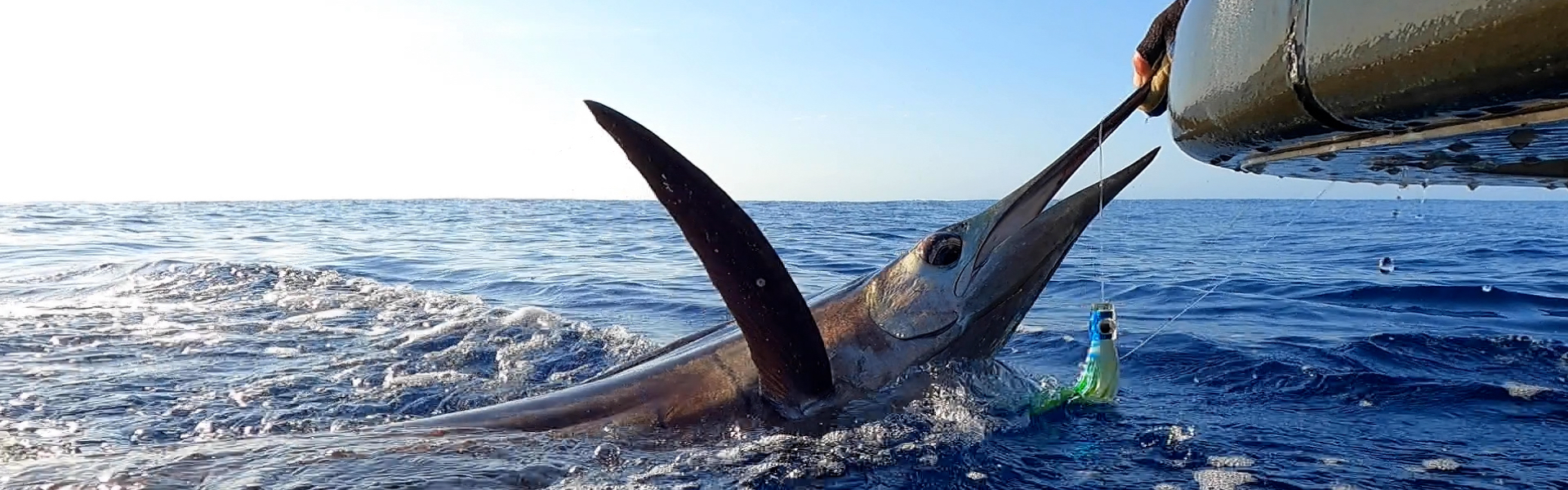
    When hanging, the fish should be broadside to the camera with the fins fully extended and with the tip of the jaw and sword or spear clearly shown. Do not hold the tip of the fin. Do not hold the fish in your hands. A sky background for the fish is most desirable. Backgrounds cluttered with objects and people may complicate identification and detract from the photograph. When photographing a fish lying on its side, the surface beneath the fish should be smooth, with a ruler or marked tape placed beside the fish if possible. Photographs from various angles are most helpful. An additional photograph on the scale with actual weight visible helps to expedite the application. Photos taken during daylight are highly recommended.
    (e) Where a two hook rig was used, a photo or tracing of the actual hook arrangement indicating the measurements.
    (f) Where a plug or artificial lure was used, a photograph of the plug or lure, indicating the measurement. If this is not completely satisfactory the plug itself may be requested. (Refer rule H1 in the Australian Angling Rules).
    (g) Applications for Australian Freshwater and Saltwater Fly Rod Records shall be on the same basis as applications for other GFAA Records.
    (h) Where a capture is the subject of a claim for both a World and an Australian record both appropriate filing fees are payable. GFAA shall issue a certificate for each capture which is approved as an Australian Record, or a tie for an Australian Record.

World Records

A claim for both an Australia and World Record must be forwarded to the GFAA Recorder through the state branch in whose water the capture was made. The claim must be made on both the GFAA prescribed form and on the IGFA 'Form for Recording Record Game Fish Captures', which may be obtained from the Secretary of a state branch or affiliated clubs, or from GFAA. Application forms must be completed in every detail personally by the angler, and must be accompanied by:
(a) an affidavit attested by a notary public or justice of the peace.
(b) line samples as for a GFAA record.
(c) photographs as for a GFAA record.
(d) a filing fee as specified on the IGFA application form

Claims will not be accepted by IGFA if the date of the catch is more than three months before the date of receipt of the claim by IGFA.
IGFA required that the claim be witnessed by a representative of IGFA, or a club official, if available.
IGFA Rules and Regulations change from time to time, and anglers are advised to check these before submitting a claim.
Any deliberate falsification of an application will disqualify the applicant from any future IGFA World Records.
On acceptance of a World Record, an Australian Record will be granted, provided that it meets the GFAA requirements and was applied for on the prescribed form.

Affiliated Clubs

All clubs affiliated with state branches must adopt GFAA rules as part of their constitution.
Where a non-member angler captures a fish which obviously approaches a world record, affiliated clubs are asked to co-operate to see that the fish is properly weighed, measured, witnessed, photographed and registered according to the requirements of IGFA.


APPENDIX A

Testing of Lines for Australian Records

  1. The line testing will be conducted on the GFAA-owned Instron Machine or by an approved testing laboratory in accordance with the Australian Standard AS2001-2.7 Determination of Breaking force and extension of yarns.
  2. The Standard AS2001-2.7 will be varied to reduce the number of tests on each sample to not less than three (3) and not more than five (5).
  3. The line will be conditioned prior to testing by soaking for two hours in distilled water complying with British Standard BS 3978 (1966).
  4. The mean of the tests will be calculated and this figure will be the accepted test figure for the determination of the claim.

Precis of the Australian Standard AS2001-2.7

(a) The machine on which the testing will be conducted will be constantly rate-of-extension type, complying with the requirements of Grade B machines specified in Australian Standard 2193
(b) The test specimen will be extended at a constant rate of 20cm (+/- 2cm) per minute.
(c) Specimens will be tested using a gauge length of 500 mm (+/- 1mm).
(d) The fixed and moving jaws will be in the same plane and at right angles to the direction of traverse. Bollard jaws will be used, so constructed that they do not damage the test specimen.


Copyright Game Fishing Association Australia 1999

 
GFAA R&D Foundation National Association Information State Association Information Related Links Game Fishing Rules and Regulations Junior Happenings and Tournaments Sanctioned Identification List Record Application Details Species Idenification Database Tag and Release Information Game Fishing Association Australia Australian Game Fishing Records